Tech Industry Market Dynamics: How AI and IoT Are Reshaping Workforce Growth

Tech Industry Market Dynamics: How AI and IoT Are Reshaping Workforce Growth and Competitive Barriers
By [Author Name] | [Date]
---
Introduction: The Twin Forces of Growth and Concentration
The U.S. tech industry is poised for an extraordinary expansion over the next decade—its workforce is expected to grow at roughly twice the national average. Yet this headline masks a deeper, more unsettling reality: the lion’s share of that growth is likely to be captured by just seven companies—Apple, Microsoft, Google (Alphabet), Amazon, Meta, Nvidia, and Tesla—collectively known as the Big7. These giants already command a dominant share of market capitalization, talent, and innovation output.
This creates a central tension. On one hand, emerging technologies—artificial intelligence (AI) and the Internet of Things (IoT)—are powerful engines of economic growth, opening new markets and driving demand for specialized skills. On the other hand, the same technologies are raising the barriers for new entrants, deepening the competitive moats around incumbents. AI requires massive data infrastructure and compute power; IoT depends on proprietary ecosystems and network effects that reward scale. The result is a tech industry market dynamics where rapid innovation coexists with increasing concentration.
This article explores how these twin forces—workforce expansion and market entrenchment—are reshaping talent flows, supplier relationships, and policy debates. We will examine the hidden economic logic that makes it harder for startups to compete, even as the overall pie grows, and what this means for the global technology landscape.
[IMAGE: Data visualization showing U.S. workforce growth vs. tech workforce growth projection with Big7 market share overlay. The left bar shows overall U.S. job growth at, say, 5% over a decade; the right bar shows tech workforce growth at 10%+, with a shaded portion representing the Big7 share.]
---
Workforce Growth: Is the Boom Reaching Beyond the Giants?
The Bureau of Labor Statistics projects that employment in computer and information technology occupations will grow 13% from 2020 to 2030—about twice the average for all occupations. That translates into hundreds of thousands of new roles each year. But where are those roles being created?
A careful analysis of job postings and hiring trends reveals a stark pattern. The Big7 alone account for more than 20% of all tech job openings in the United States, and their share is rising. These companies benefit from powerful economies of scale in recruitment: they can offer compensation packages that are often 30–50% higher than those at mid-size firms, along with stock options, brand prestige, and access to cutting-edge research.
Smaller firms and startups struggle to compete. According to a 2024 study by CompTIA, over 60% of small tech businesses reported difficulty hiring AI and IoT specialists—skills that are in acute demand. Machine learning engineers, IoT architects, and cybersecurity analysts command six-figure salaries that many early-stage companies simply cannot match. The Big7, with their deep pockets and global brand recognition, absorb a disproportionate share of this talent.
The hidden pattern here is a talent "hoarding" effect. Even when Big7 companies don't have immediate project needs for certain specialists, they hire them preemptively to prevent competitors—both large and small—from gaining access to scarce expertise. This behavior reinforces their dominance and raises the cost of entry for new players. The question then becomes: Are startups and mid-tier firms doomed to fight over scraps, or can they carve out niches that the giants ignore?
[IMAGE: Infographic comparing hiring rates at Big7 vs. mid-size tech firms vs. startups, with talent flow arrows. Big7 shows a dense inflow of data engineers, AI researchers, and IoT specialists; startups show a thin trickle. Labels indicate average salary differences.]
---
The AI and IoT Revolution: Driving Change While Raising Barriers
AI and IoT are often described as transformative technologies, and for good reason. AI enables machines to mimic human intelligence—decision-making, speech recognition, natural language processing—while IoT connects physical devices to the internet for real-time data exchange. Together, they power everything from smart home assistants to predictive maintenance in industrial manufacturing.
Consider two real-world applications: In healthcare, IoT sensors worn by patients continuously monitor vital signs and transmit data to AI algorithms that can detect early signs of cardiac events. In manufacturing, IoT-enabled machinery sends performance data to AI systems that predict failures before they occur, reducing downtime by up to 40%. These innovations create enormous value and open new markets for tech workforce growth.
Yet the very nature of these technologies creates formidable market entry barriers. AI requires vast amounts of labeled training data, expensive computing clusters (GPUs, TPUs), and sophisticated model evaluation pipelines. IoT demands a robust hardware layer, secure communication protocols, and cloud infrastructure capable of processing billions of data points per second. The upfront capital investment can easily reach tens of millions of dollars before a single product is launched.
Moreover, both technologies benefit from network effects and data moats. The more users an IoT platform has, the more data it collects, and the better its AI models become. This creates a virtuous cycle for incumbents—and a vicious one for newcomers. A startup building a medical IoT device, for instance, must not only raise capital for R&D and regulatory approvals but also compete with Google’s health AI division, which already has access to anonymized patient data from millions of users of its health apps.
The irony is acute: the very technologies that promise to democratize innovation—AI and IoT—are simultaneously deepening the competitive moats of established players. As a result, the tech industry market dynamics increasingly resemble a winner-take-most environment where first movers with scale can sustain their advantages indefinitely.
[IMAGE: Diagram of an IoT ecosystem with data flowing from sensors to an AI cloud platform. Arrows are labeled with costs: "Hardware R&D: $5M+", "Cloud Infrastructure: $2M/year", "Data Labeling: $1M+", "Regulatory Compliance: $3M+". Checkpoints labeled "Data Privacy Audit" and "FDA Approval" appear along the flow.]
---
Market Entry Barriers: Capital, Compliance, and the Big7 Advantage
The barriers to entry in today's tech landscape can be grouped into two primary categories: capital requirements and regulatory compliance. Both are rising rapidly, and both disproportionately favor incumbents.
Capital Requirements. Building an AI-powered product from scratch now demands significant financial resources. A single training run for a large language model can cost tens of millions of dollars in compute time. While open-source models have reduced some costs, fine-tuning and deployment still require specialized hardware and engineering talent. For IoT, the hardware development cycle alone can take 18–24 months, with prototype manufacturing requiring substantial upfront investment.
The Big7 have nearly unlimited access to capital. Apple, Microsoft, and Google each hold over $100 billion in cash reserves. They can afford to lose money on new ventures for years, acquire promising startups before they become threats, and subsidize entry into new markets. Smaller players, by contrast, must rely on venture capital—which has become more selective in the post-zero-interest-rate era. The average Series A round for an AI startup in 2024 was $15 million, up from $8 million five years earlier, but still far below what is needed to compete with the Big7's internal R&D budgets.
Regulatory Compliance. As governments worldwide tighten rules on data privacy, AI ethics, and cybersecurity, compliance has become a significant cost center. The European Union's AI Act, for example, imposes strict requirements for high-risk AI systems, including documentation, human oversight, and transparency. The U.S. is moving toward similar frameworks, with the FTC increasingly scrutinizing algorithmic bias and data collection practices.
For a startup, navigating these regulations requires hiring compliance officers, legal teams, and auditors—a fixed cost that does not scale down. For the Big7, compliance is a manageable line item spread across thousands of products. They have the resources to shape regulations through lobbying and industry groups, further entrenching their position. Regulatory compliance tech has become a booming sub-sector in itself, but one that largely serves large enterprises.
These barriers create a self-reinforcing cycle: high capital requirements and regulatory hurdles mean that only the biggest players can easily enter new markets. Once they enter, their economies of scale and brand recognition further deter competition. The result is a market structure where even rapid tech workforce growth does not translate into a broader distribution of opportunities.
[IMAGE: A split visual: on the left, a tall wall labeled "Barriers to Entry" with blocks reading "Capital: $50M+", "Regulatory: AI Act, GDPR, HIPAA", "Talent: Scarce AI Engineers". On the right, a Big7 logo (Apple, Microsoft, Google) sits atop a fortress with a moat labeled "Data Network Effects".]
---
Long-Term Implications for Supply Chains, Talent Distribution, and Global Industry Structure
The concentration of growth and innovation among the Big7 has profound implications beyond the tech sector itself.
Supply Chains. As these companies expand, they gain outsized leverage over suppliers. Apple, for instance, can dictate terms to chip manufacturers, display makers, and assembly partners. Similarly, Amazon Web Services (AWS) dominates cloud infrastructure, meaning that most AI startups run their workloads on infrastructure owned by a direct competitor. This vertical integration raises concerns about innovation bottlenecks: if one company controls a critical layer (e.g., cloud compute or chip design), it can influence the pace and direction of technological progress across entire industries.
Talent Distribution. The "brain drain" from academia and smaller firms to the Big7 is accelerating. Top AI researchers, who once might have started their own labs or joined startups, are now offered multi-million-dollar compensation packages to work on internal projects. This concentration of talent slows the diffusion of expertise into other sectors—healthcare, agriculture, energy—where AI could have transformative effects but where profit margins are thinner.
Global Industry Structure. The dominance of U.S.-based Big7 has geopolitical implications. Countries in Europe, Asia, and Africa find it difficult to build homegrown competitors because they lack the scale of capital markets and the depth of venture funding seen in Silicon Valley. The result is a form of digital colonialism, where core AI and IoT platforms are designed in the United States, with other nations relegated to providing data and serving as end-user markets. Regulatory pushback, such as the EU's Digital Markets Act, attempts to level the playing field, but enforcement remains slow and patchy.
[IMAGE: World map with the United States highlighted as the center of Big7 headquarters. Arrows show capital, talent, and data flowing from Europe, Asia, and Africa into the U.S., while finished products and services flow outward. Smaller arrows indicate attempts at regulation (e.g., EU AI Act) pushing back against the flow.]
---
Conclusion: Can We Have Both Growth and Competition?
The tech industry is at a crossroads. The forecast for workforce growth is undeniable: AI and IoT will create millions of new jobs, fueling demand for engineers, data scientists, and cybersecurity experts. But the structure of that growth is increasingly skewed toward a small number of dominant players.
The tension between rapid innovation and market concentration is not inevitable. Policy interventions—such as data portability requirements, open AI model standards, and targeted grants for startups in high-compliance sectors—could lower entry barriers. So could the emergence of new business models, such as decentralized AI networks or cooperative IoT platforms that share data and infrastructure.
Yet without deliberate action, the current trajectory suggests a future where the Big7 control not only the most valuable technology platforms but also the talent pipeline, the regulatory frameworks, and the supply chain nodes that underpin the entire industry. For smaller players and new entrants, the challenge will be not just to innovate, but to survive the gravitational pull of the giants.
The hidden economic logic behind these dynamics demands a broader conversation—one that weighs the benefits of scale against the costs of concentration. The tech industry market dynamics we see today are not a natural law; they are the result of policies, market structures, and strategic choices. Understanding them is the first step toward ensuring that the next wave of growth benefits more than just the biggest players.
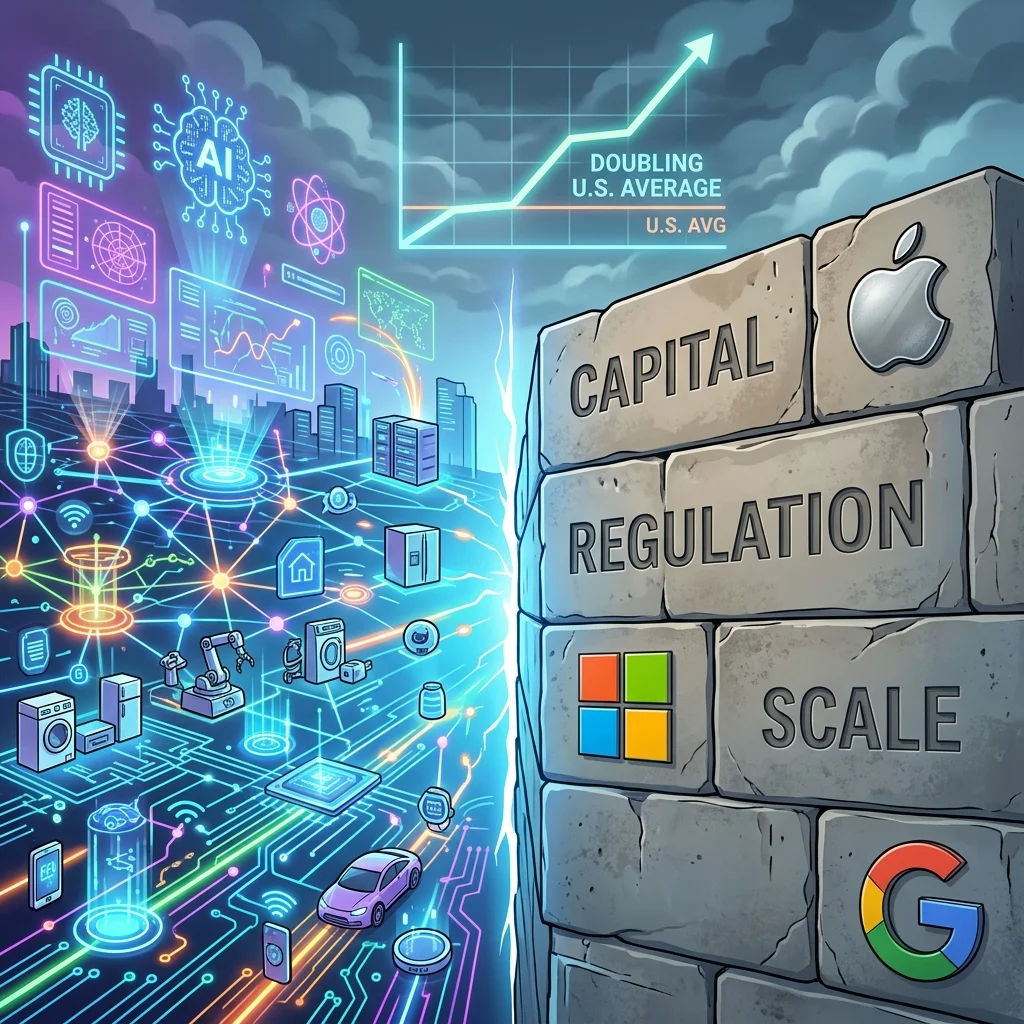
[IMAGE: A futuristic cityscape split into two halves: left side shows vibrant, colorful IoT nodes and AI light trails, representing innovation and growth; right side shows a gray, monolithic wall with logos of Apple, Microsoft, and Google embedded, and a graph in the sky showing workforce growth doubling the U.S. average. No text or watermarks.]
Written by
Elena VanceTech-savvy analyst covering emerging technologies and digital innovation.
View all articles